-
Phobos: A Galaxy Jones Story

Phobos: A Galaxy Jones Story is the sixth game by Phil Riley, and the second one in the Galaxy Jones series. He’s the author of Bureau of Strange Happenings, a game I didn’t make it that far into, and he came out with Crash, the same competition that I released Into The Sun. I didn’t play the first Galaxy Jones game, but I had a fun time with this one.
The game starts off with the standard: the world is about to end, and you need to save it. But this time, the world is Mars. Robots from Sirius have redirected Phobos to crash into Mars. Once you get to their base, you’ll find it’s cleared out. You have to piece together what went on by reading notes and scanning logs.
The game is not written in the standard IF format. There is no second person, and the rooms don’t have the standard titling. The layout is small and easy to get around without a map, but the rooms do feel similar without the titling. The rooms are fairly empty too, and I kept trying to look at things that weren’t there when I was lost. It also uses some strange ASCII characters to create its own language. At one point, you have to look at it very closely to figure out how to advance in the game. It’s a neat idea, but I don’t think this would work on a screen reader.
The game also requires you to use non-standard verbs. So you will need to examine all your items to figure out how they work. If you get caught up in the game and forget about these verbs, you’ll get stuck as I did. Don’t forget these tools in order to beat the game.
The game does have a clever device: the Galaxy Suit. You can turn it on to break down doors, getting past some of the puzzles. You don’t get any points, but it does let you advance through the game. I went through four doors like this. My score suffered, but I like that I had this choice to get around some of the puzzles.
Phobos does a lot of things right. It’s a quick space adventure, and if you don’t get stuck like I did, you should be able to get through it within an hour. At the heart of this game, you are alone in a deserted station, trying to figure out what happened. A classic IF trope. Phil took that idea and ran with it, coming up with a fun space adventure.
-
Gun Mute

Gun Mute is the first game released by C.E.J. Pacian. I remember when it came out. There was a lot of hype around it. It’s a great game. But, I think, it’s also one of the first to use a limited verb set. Something that hadn’t been seen up to that time. It’s full of action, and there’s something to do in every room.
In this one, you start off in the desert next to an old woman waiting for a brew that will zero in on your enemy. Hence, the reason you only need to use FORWARD or BACK when moving around. And every room was put together differently. You also have to look at the environment carefully and time things out. You do a lot more than just shoot stuff. This creates a lot of interesting puzzles that have you interacting with the environment to make it out of the room.
The game is short, with only 14 rooms to get through. Each room is a puzzle. They do start off easy and get progressively harder. But with a hint or two, you’ll be able to get through it. And there is a hint system built in. I did get stuck a few times, but once you figure out how the game is put together, it becomes really fun trying to figure out each room.
Most people have probably already played this game. It’s a fun one. Quick, with only a handful of rooms, and not too hard. It’s a great example of what can be done with a limited parser. So anyone trying to make their own should take a look at Gun Mute. It proves you only need a handful of verbs to deliver a great experience.
-
The Curse of the Scarab
The Curse of the Scarab is a surprisingly complex game written by Nils Fagerburg. On the surface, it looks like a simple grab-all-you-can type of game – inspired by Captain Verdeterre’s Plunder and Sugarlawn, both amazing optimization games on their own. But Curse of the Scarab is its own thing. There are puzzles along with limits, mobs that will try to kill you, and scarabs that want to eat. In the end, how much you make from the treasure becomes your score. The more you make, the better. As of writing this, Wade Clarke holds the highest score of 1585 pounds.
*** Spoilers from here on out
This type of game can be played several times, seeing different stuff during each playthrough. You start out by focusing on the pit, but there are clues that lead to the desert and back again. The goal is to make as much as you can by stealing everything from the tomb. You need to escape Egypt due to your exploits. It looks like this isn’t the first burial chamber you robbed. It’ll cost you the Scarab Amulet to get out of the country, but there is so much more to find in the tomb.
There’s everything you would expect to find in an Egyptian tomb – plenty of loot, puzzles to unlock, and a Mummy. Yes, waking up the Mummy can be very deadly – he’ll chase you around. And that’s the cool part about the game. You’ll do stuff, get yourself in trouble, and then work your way back out of it. Or die, which can happen a lot too. Some deaths are funny, and some are cruel, but I keep coming back to this game anyway.
The game uses a custom parser, which is a bit of a turn-off. Because it uses its own parser, the benefit is it can display custom graphics and Egyptian hieroglyphs, but I would love to have a z8 or glulx file for it so I could play it on my iPad whenever I want. The interface is cool. I do like the graphics and the hieroglyphics add to the game, but locked into itch.io like this, there’s no portability. I’d rather not be forced to use a browser to enjoy an I.F. game.
This game also has an inventory limit with a bag that can only hold four items. The same goes for the player. But the game challenges you to find different ways around it, like wearing certain pieces of treasure – a great idea. There’s also a time limit. You have a torch that can burn out. If this happens in the tomb, you’ll die. Scarab’s are afraid of the light but will feast on your flesh in the dark. One good thing about the limit is time doesn’t advance when the player looks at something. It only increases when doing stuff. Also, like any good adventure, there’s a way to refuel the torch.
Another unique thing I found about the game was that there are cursed objects or ways for objects to become cursed. The game is called The Curse of the Scarab. You have to be careful because the Mummy can fry things, or certain things are already fried. So when you do return to Saad, you don’t want to have any cursed items. You’ll get nothing for them.
This game is fun, really fun to play. It’s simple enough to get into the tomb and beat. You’ll die a few times, but walk away with a good sense of what’s happening. Later, you can delve back into that scarab-infested pit. And start to mess with that Mummy as you take everything not nailed down, hopefully coming away with half of what Wade did. That must have been an incredible run.
-
Captain Cutter’s Treasure

Captain Cutter’s Treasure has to be one of the best games that Garry Francis has written. If not the best. It’s written in PunyInform, and the z3 can be played on a real Apple II+ if you use something like Interl under Linux to make your boot disk.
This game starts in a broom closet, like all games for PunyJam #1. This game also took first place in that competition, for good reason. This writing prompt hit the author in the right spot. Everything fits together, snapping in place. For something this small, there are several characters that you can talk to as you take in the world. All of them are needed because they are tied into the puzzles one way or another, and being able to ask them about subjects, a way of talking to NPCs in parser games, filled in a lot of what was going on.
On my first play-through, I ran into some ASCII art that looked like part of a maze’s map. But after sticking with it a second time, it turned out that this was only a clue, done in ASCII art. It worked, but it also drove me away, thinking that there was a maze somewhere in this game. Mazes have turned out to be more trouble than they are worth in interactive fiction.
But there is a warehouse in this game. It’s big enough to map. One could call it maze-like. It’s only ten rooms, but navigating them can be a little hard to imagine, so a map helps. Once I had a good idea of the layout, I was able to complete the puzzle and navigate the place properly. I also felt that I had everything I needed to rip off Cutter in order to steal his gold. I just couldn’t figure out how to open his chest. So I gave in and made my way to his ship.
*** Spoilers ***
There was one thing that snagged me, and that had to do with the mouse hole. Every time I tried to look inside the hole, it said:
No way. There might be a mouse in there.Even after finding the lamp and turning it on, it says the same thing. So this lead me to believe that there was nothing I could do about it. Even though it says, when you try to get to the boat, you’re missing something from the closet. So I looked it up. Thank you David Welbourn. I wasn’t too happy to find out that all I needed to do was look at the hole with the lamp on. Not inside, just examine it. I feel cheated. The game failed me there. I did look up a few other things, so I wasn’t going to finish the game on my own. I just wanted to get all the puzzles that I could.
*** Spoilers Off ***
After you get the girl back, the game ends. You finished the task you were sent out for. But I was right about being able to cheat Cutter out of his gold because the game said that I could do better. There are an extra five rooms on that ship and a lot of stuff to do. It’s like I’ve only seen about half the game. And that’s great. Because with something like this, you can play the game over a few more times, finally getting one over on Cutter. Though I’m sure he would come back for you. He knows who made the deal.
Captain Cutter’s Treasure is a great game. There’s a lot to do in the seaport, with lively characters to run into and a few puzzles that tie everything together. It’s a medium-sized game with 32 rooms, making it very portable. It can be played on almost any old-school platform. And there’s enough there to come back for more. I know I’m going to try it again. Cutter is not getting away with all that treasure!
-
Impossible Stairs
Impossible Stairs is a medium-sized puzzlefest crafted by Mathbrush. This game is an authorized sequel to Impossible Bottle, a story that tied for first place in the 2020 IF Comp. In this game, a series of puzzles bring your family together for a meal by the end of it. It’s a light-hearted adventure and not overly difficult. However, I did need some of the hints to make it to the end.
The game does start with a tutorial, so this one might be good for newcomers to the genre. It also has a hint system that will carry the player through to the end. I shut off the tutorial right when I started playing. I didn’t want it giving away any actions I should do. But the hints I did use a few times. They were a little clunky with specific topics and could use a few more synonyms, but I managed to figure them out.
The game itself is a time-zone puzzle, where going up and down the stairs will shift the player by 20 years. There are only six rooms in each zone, with a total of five time zones to play through. As you play, you find yourself going up and down the stairs a lot, piecing each puzzle together. And the puzzles are interconnected, giving the whole house a solid feeling. Even though there are over 30 rooms, the layout is small and easy to keep in your head. But as you play, it does become a bit to manage, and it was hard to know what to focus on. I had to use the hints.
There’s something special going on here, with bringing your family together for the last dinner, so to speak. Because here, when you get to the later time zones, you can see the house has been sold. You’re moving out. So bringing everybody together for a final meal works and pulls on the heartstrings. Also, who was that woman in the window? Was that the PC’s Mom? He didn’t really know his Mother, so she could’ve been. That part didn’t resolve, or maybe it’s buried in the code somewhere, and I missed it. But everything came together really well, and I enjoyed it a lot. There is a story worth playing here.
-
You Won’t Get Her Back
You Won’t Get Her Back is a text game by Andrew Schultz. Or maybe a text puzzle. He has written a lot of games over the years and even gamified IF with Big Nose on the Big Pyramid. Here he’s implemented a version of chess, the full board, not like his previous game, Fourbyfourian Quarryin’, but it plays tight. There are not a lot of extra moves. It’s a bit on rails.
This one has you in the final moves of a chess game, trying to get a checkmate, not a stalemate. You have a pawn and king, the enemy, a rook and king. The pawn starts off two moves from being queen. It took some time to get used to it. But after I read the verbs, thanks to Drew Cook, the game became easier to play. This isn’t to say I beat it, but I did get a stalemate. And even knowing the verbs, it’s easy to make a mistake, and the puzzle will reset itself.
Making your way through the game is tricky. And when you do fail, you can get achievements. Failure is easy, though. And when it happens, it’s hard to visualize the final moves. It’s explained to you, but you don’t see where the pieces end up. The explanations are neat, but not being able to see the final layout makes it hard to finish the game.
With some tweaks, this game might be easier to play. But the puzzle was hard, or hard for me, and too tight to finish. I like chess. I like the idea of it being implemented in Inform, but that’s a near impossibility. Andrew made an interesting puzzle out of it. Too bad I couldn’t finish it. Maybe if he puts in the full board during the final move, I could grasp it a little better.
-
Alchemist’s Gold
Alchemist Gold is a text adventure written by Garry Francis. It was written in PunyInform and is only 82kb. That’s tiny. Really tiny. My first game was 512kb by the time it was done. I wasn’t using a stripped-down version of the library, but you can only put in so much with a game this small.
In this one, you hear of an Alchemist that lives deep in the woods, having mastered his art with the ability to create gold. The game starts off with a gated puzzle that keeps you out of the magic forest. This is typical for this type of game. Having a small area to get use to before jumping deeper into the game.
And the next part is a bit of doozy. It’s a maze that is navigated by an ASCII map. I like it a lot. It works well for me. Once you figure out the path, it’s not hard to get around. But I did venture back and forth three times, so that got a little old. I would have liked a MAP command that would show you the map. Not X MAP. Just to help speed up the navigation of the forest.
Then there’s the final puzzle – getting in and stealing the gold. I had a few problems with this section, trying to find the right thing I needed, but in the end, with some perseverance, I managed to get the booty and make it back out of the forest. Only to find an alchemist who turned me into a frog. I went back and got all the stuff and tried things like putting the sack on the gold to cover it, hiding it from the alchemist, but nothing worked.
In the end, he got the better of me, and I don’t know if it could have ended differently. You would think there is some way to sneak around the alchemist. When you do find him, you can get him to sort of follow you as you go back, but the idea of venturing through the forest a fourth time was too much, and I let him win.
In the end, it’s a fun game with some meat on the bones. There’s enough puzzle to keep you going for a bit, and it will even run on older machines. Making it a good candidate for some retro streamer to play.
-
Midnight at Al’s Self Storage, Truck Rentals, and Discount Psychic Readings

For the start of ParserComp 2022, I played Midnight at Al’s Self Storage, Truck Rentals, and Discount Psychic Readings by Thomas Insel. I had pretty high hopes for it, and even though it’s a short game, I feel it missed an opportunity.
You play as an employee at an all-night self-storage. Your boss, Joe, hands you a list as he heads off to god knows where. You have to move a few boxes around and settle things with a wary spirit. It’s a short game, something that could have been put together fairly quickly for the competition. And probably for that reason, there are no strange characters that show up in a place like this.
Putting in characters is hard, and it takes a lot of work. I’ve even shied away from NPCs in some of my games. But with a title like this, Midnight at Al’s Self Storage, Truck Rentals, and Discount Psychic Readings, I feel someone should have shown up to throw a wrench in it all. Or three. It reminds me of some old-school zaniness from back in the 80s, like Repo Man. I could see Harry Dean Stanton playing Joe, messing with the PC as they haul stuff around.
I enjoyed the game. It’s short and easy, with one puzzle to work around that makes a lot of sense. It feels like its own little place, with a terrible storm raging outside. I just wished that author went a little further and brought some characters into the mix.
-
The Bright Blue Ball
The Bright Blue Ball by Clary C might be the last game I review for Spring Thing 2022. It’s getting towards the end of the competition, and I know who I’m voting for. But I wanted to give a few more games a fair shake.
In this one, you play as a dog, looking for his bright blue ball. The game is short, intended for children, and easy to play. But it also has a lot of generic responses to things I tried out. Nothing major, but in a game this small, you’d expect to see it polished from one end to the other.
The things I found lacking were simple, like pushing or pulling objects in the game. I got mostly generic responses from this. And it also seemed a little strange that my family started calling after me right after I left, and they were all asleep. Unless I missed it, no one woke up and noticed I had left. The game just started echoing out that my family was looking for me. I also think that some verbs could’ve been added like BITE and then implement some cute responses. But the game doesn’t need to go that far.
Overall these are minor points, and this is a cute game. I think it hits the target audience for kids spot on. It’s easy enough for them to play, and they’d overlook all the smaller things an experienced player might try. It is a little light on the implementation for my tastes. I’d give it a 7.
-
Tours Roust Torus
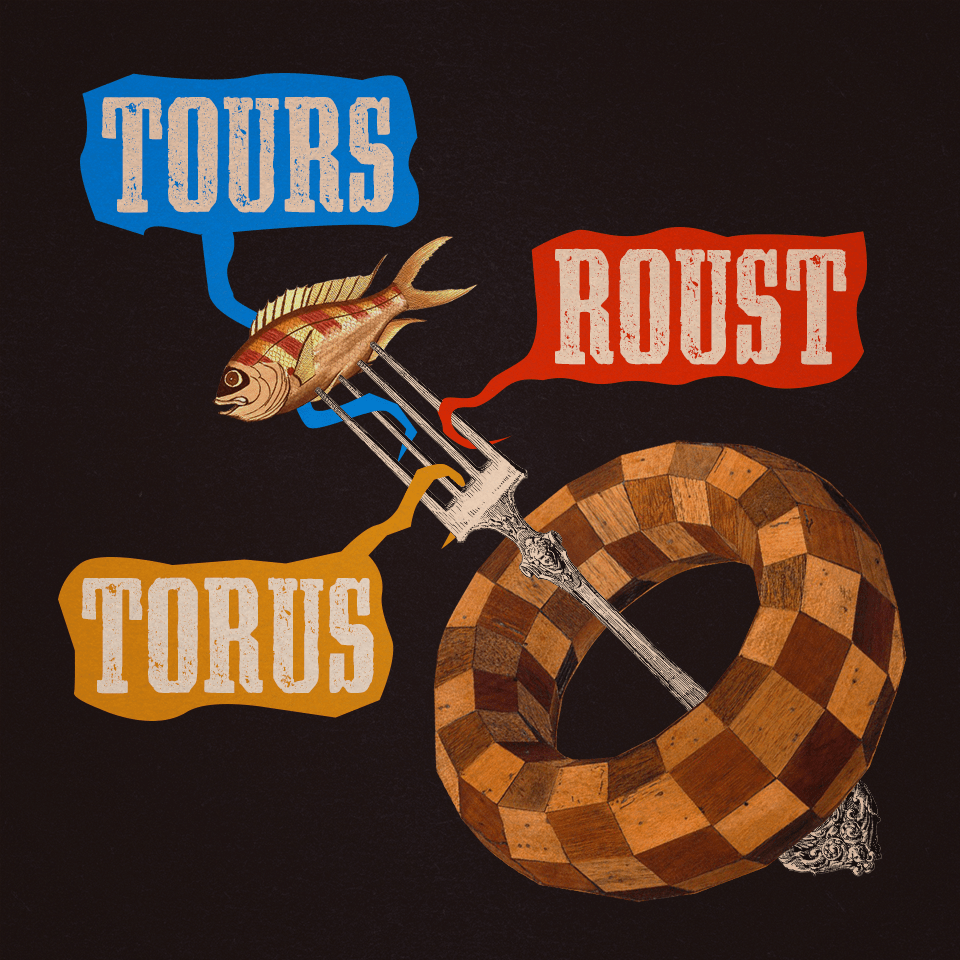
It’s getting towards the end of Spring Thing, but I’d like to get a few more reviews in. The latest game I played was Tours Roust Torus by Andrew Schultz – an anagram game that’s the final installment in the Stale Tales Slate. Going into it, I expected a game where I could win it with an anagram solver, but I got stuck on the final puzzle and couldn’t finish it.
A lot of work must go into these games. Just coming up with the different anagrams has to be tough. While designing a game might be fun in the beginning, after three of these, I’d think it’d be hard to come up with more. And the game starts with a bit of that, a melancholy look back on life.
The design is simple and effective. You circle around a central room, solving anagrams and changing the environment. It took me a bit to get what was going on, I got stuck on the first one, but then it started to roll. I made my way through seven of them quickly, but then the final puzzle took a turn. I can only guess that it has something to do with reordering the rooms. It’s not an anagram puzzle that I could cheat, and after trying to brute force it, I gave up.
Tours is a fun game that has some light puzzles at the beginning that help shape the setting. It was a little strange, but I ran with it, and it seemed like it was going a little dark. Was I rebuilding Frankenstein? I never did get to the center of the lollipop. That last puzzle was beyond me. Still, I’m glad I played it. It was fun to rearrange the furniture.
-
Subscribe
Subscribed
Already have a WordPress.com account? Log in now.
 Grue Eater